· ReadyStack
Worked example
Real numbers from this tool, line by line.
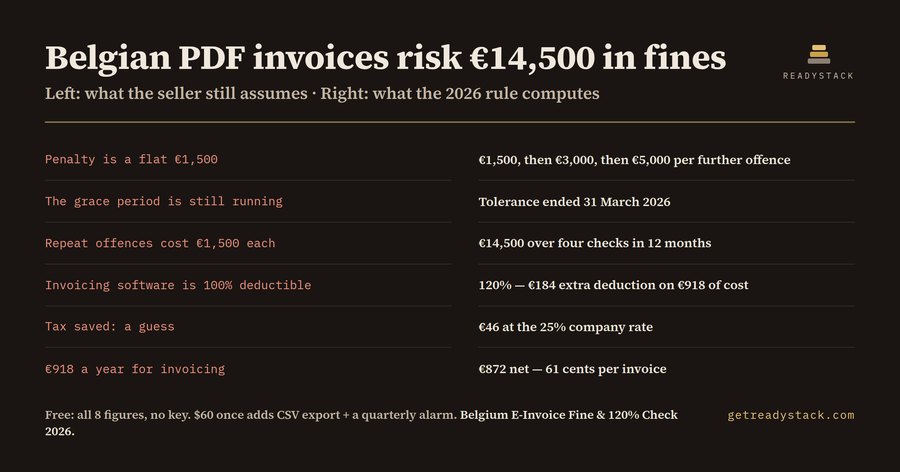
€14,500. That is what a Belgian bookkeeper's client can be charged in twelve months for carrying on with PDF invoices, and almost nobody in Flanders or Wallonia is quoting that number yet — they quote €1,500.
Mandatory structured B2B e-invoicing over Peppol has applied in Belgium since 1 January 2026. The part that changed quietly is the tolerance period: it ran to 31 March 2026, and after it the penalties in the Royal Decree are enforced. They are not flat. The first established infringement is €1,500, the second €3,000, the third and every one after it €5,000 — and an infringement only counts as the next one in the ladder if it is established more than three months after the previous one. Four checks a quarter apart over twelve months are €1,500 + €3,000 + €5,000 + €5,000 = €14,500.
That is the first number this browser extension computes. Type how many infringements have already been established and how long an audit horizon you want to look at, and it steps through the ladder instead of repeating €1,500. A client who has already taken one fine and looks six months ahead sees €3,000 as the next one and €8,000 over the horizon. A larger firm with two behind it and a two-year horizon sees €5,000 next and €40,000 over the horizon.
The second number makes the conversation bearable. For financial years 2024 to 2027, Belgian small companies and sole traders deduct 120% of what they spend on e-invoicing software — subscription fees and implementation consulting, not depreciation on capitalised software. Take the defaults in the popup: €39 a month for a Peppol package plus €450 of onboarding is €918 of eligible cost in year one. The extra 20% slice is €184; at the 25% corporate rate it saves €46 of tax, so year one costs €872. Across 120 B2B invoices a month that is 61 cents an invoice, and one €1,500 fine pays for 20.6 months of it.
Change the client and the answer changes with them. A sole trader at €19 a month with no onboarding fee, taxed at the 50% bracket, is at €228 eligible, €46 extra deduction, €23 of tax saved and €205 net — 43 cents an invoice on 40 invoices a month. These are not lookups in a table; the extension runs the arithmetic in the page and the figures move as you type.
Why not just ask an assistant? Because they answer with the grace period. Ask a general chatbot today what a Belgian company risks for a PDF B2B invoice and the reply still lands on the tolerance window that closed on 31 March 2026, and on a single flat €1,500. The three-month rule and the 2024-2027 window on the deduction are exactly the year-stamped detail that goes stale in a model.
Everything above is free: the popup and the free web page share one file of arithmetic, nothing is sent anywhere, and there is no key, no watermark and no usage limit — all eight figures for one company, finished. The paid layer is a different job, not a bigger version of the same one. For $60 the key exports each run to a dated .csv for the client file and sets a recurring alarm before the next VAT quarter. One licence key per person or team seat, seven-day full refund.
For comparison, a freelance accountant in Belgium bills around €25 an hour for a junior profile and €60 to €70 an hour for a high-skilled profile at 2026 market rates.
Sources checked on 18 September 2026 and listed in the extension's README: the Royal Decree summary on the 1 January 2026 mandate and the tolerance to 31 March 2026; the €1,500 / €3,000 / €5,000 tiers and the three-month rule; the 120% deduction for 2024-2027; and Belgian freelance accountant market rates.
Questions people ask
What does this extension actually compute?
It takes your Peppol software price, onboarding fee, tax rate, invoice volume and how many e-invoicing infringements have already been established, and returns eight figures: eligible cost, the extra 20% deduction, the tax it saves, net year-1 cost, your next fine tier, worst-case exposure over your audit horizon, payback in months, and net cost per invoice.
Who is it for?
Belgian bookkeepers, freelance accountants and SME owners who still issue domestic B2B invoices as PDF. Mandatory structured e-invoicing over Peppol has applied since 1 January 2026, the tolerance period ended on 31 March 2026, and these are the people who now have to put a euro figure next to that decision for each client.
Why not just ask a chatbot or use a free VAT calculator?
General assistants still answer with the grace period that ended on 31 March 2026, and they treat the penalty as a flat €1,500. The escalation to €3,000 and €5,000, the three-month rule that decides whether an offence counts as the next one, and the 120% deduction that only runs for financial years 2024 to 2027 are all missed.
What is free and what does the key add?
All eight figures are free, with no key, no watermark and no usage limit — the calculation for one company is finished in the free popup and in the free web page. The $60 key is a different axis: it exports each run to a dated CSV for the client file and sets a recurring alarm to re-check before the next VAT quarter.
What would this cost me otherwise?
A freelance accountant in Belgium bills about €25 per hour for a junior profile and €60 to €70 per hour for a high-skilled profile at 2026 market rates. Asking one to work out the penalty escalation and the deduction for a single client costs more than the extension, and the answer is not reusable next quarter.
Ask about this tool
One question, answered by the person who built it. Your email only if you want the answer sent.